Continuous Performance (CFR)

For CHRO · VP HR · Chief People Officer · Head of People Ops

Inspire's continuous performance capability replaces fragmented HR processes — annual-only reviews, disconnected tools, and reactive recognition — with one continuous workflow built around CFR (Conversations, Feedback, Recognition). Employee performance connects directly to company goals, and managers have a system they'll actually use.

What continuous performance problems does Inspire solve?

Problem: Annual reviews that don't help people improve

→ Continuous performance conversations build a record that makes reviews accurate, fair, and development-oriented.

Problem: Goals disconnected from performance

→ OKRs and goals are embedded in every conversation and review — no separate tracking needed.

Problem: Manager inconsistency across teams

→ Structured conversation templates and review workflows standardize the process without scripting the dialogue.

Problem: Recognition is reactive, not cultural

→ Peer-to-peer recognition tied to company values, visible organization-wide.

Problem: No early warning on disengagement

→ Engagement signals in conversations and recognition patterns surface early indicators for managers.

Problem: HR has no data between reviews

→ Real-time dashboards show manager engagement rates, conversation completion, and performance trends.

How does the continuous performance workflow work end to end?​

How does the continuous performance workflow work end to end?

1
Goal Setting
Individual goals connect from OKRs or are set independently with manager input.
2
Regular Conversations
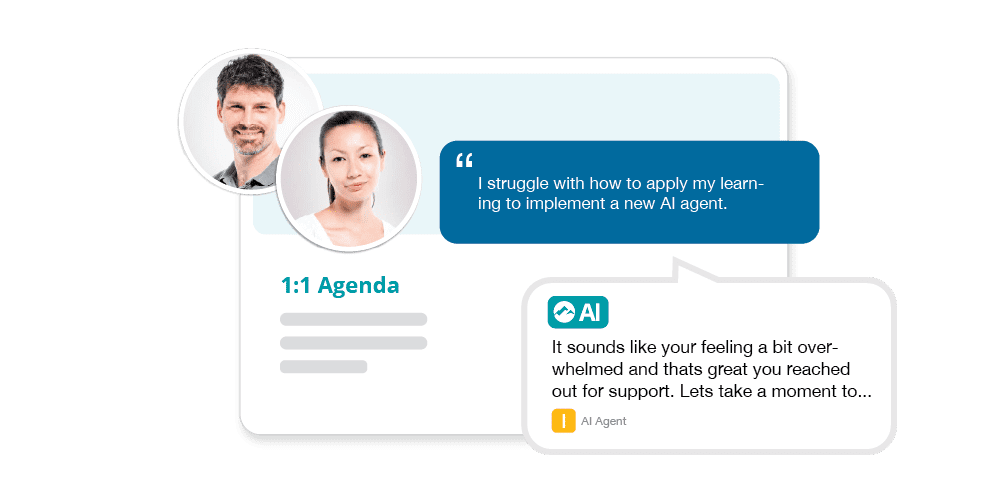
Weekly or bi-weekly manager–employee conversations (10–15 mins) with AI-generated agenda items tied to goals.
3
Peer Feedback
360 feedback requests tied to review cycles or triggered by milestones.
4
Manager Review
Structured reviews pull conversation history, OKR progress, and peer feedback automatically.
5
Recognition
Peer-to-peer and manager-to-employee recognition tied to company values.
6
Development Plans
Post-review development goals set and tracked through the next review cycle.

The Continuous Performance Gap

14%
of employees strongly agree performance reviews inspire improvement
— Gallup
~58%
of HR leaders say their performance systems fail to drive engagement or high performance
— Deloitte Global Human Capital Trends
70%
Managers account for at least 70% of the variance in employee engagement, by not being equipt with the right tools to coach
— Gallup

Learn About Inspire

Integrations and Capability

Integrations

Connects to Teams, Slack, Jira, Workday
Cloud and Software Security

AI Trust

What AI writes. What humans review.

Coaching and Support Capabilities

Coaching

Accelerate results — add process coaching.

Frequently asked questions

Continuous Performance

Does Inspire replace our existing HRIS?
No. Inspire is a continuous performance layer that sits on top of your HRIS — it doesn’t replace it. Your HRIS (Workday, ADP, SAP SuccessFactors, BambooHR, UKG, Dayforce, or another) still owns core employee data, payroll, and compliance. Inspire owns the work your HRIS isn’t built for: OKRs and goal alignment, ongoing 1-1 conversations, mid-cycle and 360 feedback, performance agreements and appraisals, and recognition. Inspire integrates with 40+ HRIS systems directly so employee records, org structure, and goal data stay in sync — no double entry, no parallel system of record.
How do you drive manager adoption of performance conversations?
Adoption comes from making the right behavior the easiest behavior. Inspire gives managers structured 1-1 and performance-agreement workflows, AI-assisted agenda items pulled from each direct report’s active OKRs and recent check-ins, and reminders inside the tools they already work in — Microsoft Teams, Slack, and Outlook. Performance cycles are configurable, so the cadence fits how your business actually runs (bi-weekly, monthly, or quarterly) instead of forcing a once-a-year ritual. Manager dashboards show conversation completion, mid-cycle comments, and goal progress across the team, so leaders can spot quiet teams early. The combined effect: less admin, more coaching, and a clearer line of sight from a daily 1-1 to the strategy it’s tied to. 
Can we customize our review process?
Yes. Performance cycles in Inspire are configurable end-to-end. Admins set the cycle dates, the steps in the cycle (Performance Agreement, mid-cycle comments, self-assessment, 360, appraisal), the terminology your organization uses, instructions at each step, who approves at each level, and the goal frameworks (OKRs, SMART goals, or simple objectives and key results) the cycle pulls from. Cadence is flexible too — annual, semi-annual, quarterly, or continuous. The result is a process that matches how your organization already runs reviews, not one you have to re-architect around the tool.
How does Inspire connect OKRs and performance without tying compensation to OKRs?
OKRs and performance reviews are connected in Inspire, but they aren’t the same conversation. OKRs are designed for stretch and learning — they drive focus and alignment to strategy. Performance reviews look at the full picture: outcomes, behaviors, growth, and contribution. In Inspire, OKR progress and 1-1 history are pulled into the Performance Agreement and appraisal automatically so the review is grounded in real work — not from memory. Inspire keeps OKR progress and performance-review outcomes in separate workflows, so your organization controls whether — and how — OKR scores influence comp decisions. Most modern organizations decouple the two on purpose: tying comp directly to OKR scores tends to push people to set safer goals, which defeats the point of OKRs.